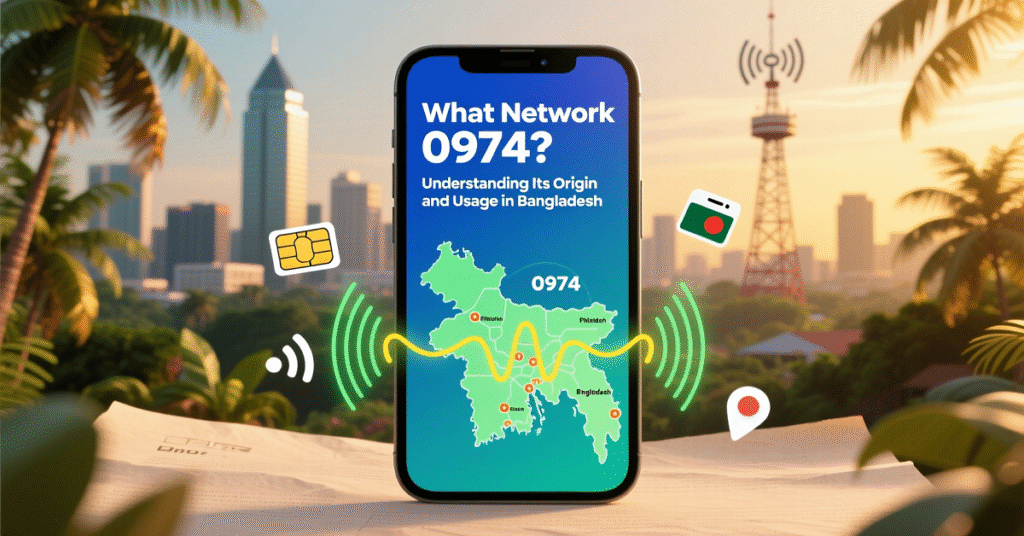
What Network 0974?
You glance at your phone. An unfamiliar number flashes across the screen: 0974-XXXXXXX. It’s not a Grameenphone number. Not Robi or Banglalink either. So what network is calling you? If you’ve ever wondered about the mysterious 0974 prefix, you’re not alone. This number series represents a fundamental shift in how telecommunications work in Bangladesh. Unlike traditional mobile networks that rely on cell towers and SIM cards, 0974 numbers operate through IP-based telephony (IPTSP services) a modern communication technology that’s reshaping how businesses connect nationwide.
In this comprehensive guide, we’ll uncover everything about the 0974 network, from its underlying technology to practical usage scenarios, helping you understand whether these numbers deserve a place in your communication toolkit.
Quick Answer: What Network is 0974?
The 0974 prefix belongs to IP telephony service providers in Bangladesh, not traditional mobile networks like Grameenphone, Robi, Banglalink, or Teletalk. These numbers operate using Voice over Internet Protocol (VoIP) technology, transmitting voice calls over the internet rather than through conventional cellular infrastructure.
The Bangladesh Telecommunication Regulatory Commission (BTRC) allocates the 0974 series specifically to licensed IP telephony operators. This means when you receive a call from a 0974 number, it’s coming through an internet-based system rather than traditional mobile towers.
Understanding Bangladesh’s Mobile Number Prefix System
Before diving into 0974 specifically, it helps to understand how Bangladesh organizes its telephone numbering system.
How Number Prefixes Work
The BTRC assigns specific number ranges to different operators and service types. All Bangladeshi mobile numbers follow an 11-digit format, where the first four digits identify the operator and service type.
Here’s how the major mobile networks break down:
| Prefix | Operator | Network Type |
|---|---|---|
| 017x | Grameenphone | GSM Mobile |
| 013x | Grameenphone | GSM Mobile |
| 018x | Robi | GSM Mobile |
| 019x | Banglalink | GSM Mobile |
| 014x | Banglalink | GSM Mobile |
| 015x | Teletalk | GSM Mobile |
| 016x | Airtel (discontinued) | GSM Mobile |
| 0974 | Multiple Providers | IP Telephony |
The Special Category: IP Telephony Prefixes
The 0974 prefix represents a distinct category. Rather than being tied to a single mobile operator, it’s allocated to multiple licensed IP telephony providers. This distinction matters because the underlying technology, cost structure, and use cases differ fundamentally from traditional mobile services.
The BTRC began issuing IP telephony licenses in the mid-2010s as part of Bangladesh’s digital transformation strategy. These services were designed primarily for business communication, offering cost-effective alternatives to expensive international calling and providing advanced features that traditional phone systems couldn’t match.
What is IP Telephony? Breaking Down the Technology
To understand 0974 numbers, you need to grasp how IP telephony works—and it’s simpler than you might think.
VoIP Technology Explained Simply
Traditional phone calls use circuit switching. When you dial a number on your Grameenphone SIM, the network creates a dedicated connection between you and the recipient through cell towers and switching stations. This connection remains open for the entire call duration.
IP telephony works differently. Your voice is converted into digital data packets, similar to how WhatsApp or Messenger handle voice messages. These packets travel across the internet to reach the recipient, where they’re reassembled into audible speech.
Think of it this way: Traditional calls are like sending physical letters through dedicated courier routes. IP telephony is like sending emails—broken into small pieces, transmitted through various internet pathways, and reassembled at the destination.
Technical Requirements
For IP telephony to work effectively, you need:
- Stable internet connection: Minimum 100 kbps upload/download speed per call
- Low latency: Ideally under 150 milliseconds for natural conversation flow
- Compatible device: Smartphone with VoIP app, IP desk phone, or computer with softphone software
The quality of your internet connection directly impacts call clarity. A 4G mobile connection or broadband Wi-Fi typically provides excellent voice quality, while congested 3G networks may result in choppy or delayed audio.
Evolution of VoIP in Bangladesh
Bangladesh’s journey with IP telephony began in earnest around 2008-2009 when the government first considered legalizing VoIP services. Initially, VoIP operated in a regulatory gray area, with many services existing unofficially.
The formal licensing framework emerged in the 2010s, bringing legitimacy and structure to the industry. Today, IP telephony is a recognized and growing segment of Bangladesh’s telecommunications market, particularly popular among businesses seeking cost-effective communication solutions.
Licensed Providers Using the 0974 Prefix
Several BTRC-licensed companies operate under the 0974 prefix, each serving different market segments:
Major IP Telephony Operators
Bangla Phone Ltd. focuses primarily on enterprise clients, offering comprehensive business communication solutions including cloud-based phone systems and integration with customer relationship management (CRM) software.
InterCloud Ltd. specializes in international calling services, positioning itself as a cost-effective solution for businesses with overseas clients or Bangladeshi expatriates maintaining connections with home.
BDCOM Online Ltd. targets small and medium businesses, providing affordable entry-level IP telephony packages with straightforward pricing and minimal setup complexity.
NovoTel Ltd. emphasizes call center solutions, offering features like automatic call distribution, real-time analytics, and quality monitoring tools that appeal to customer service operations.
Service Differentiation
While all these providers use the 0974 prefix, their offerings differ significantly:
- Pricing models range from pay-per-minute plans to unlimited monthly subscriptions
- Feature sets vary from basic calling to advanced unified communications platforms
- Target customers span from individual freelancers to large corporations
- International coverage differs, with some providers offering better rates to specific countries
Choosing between providers depends on your specific needs—international call volume, required features, budget constraints, and technical support requirements.
How 0974 Numbers Actually Work: Technical Deep Dive
Understanding the mechanics behind 0974 numbers helps explain both their advantages and limitations.
The Call Flow Process
Here’s what happens when someone dials your 0974 number:
- Initial connection: The caller’s phone (mobile or landline) sends the call to their network
- Routing to VoIP gateway: The call reaches your IP telephony provider’s gateway server
- Conversion: The analog voice signal converts to digital data packets
- Internet transmission: Packets travel across the internet to your receiving device
- Reassembly: Your device (smartphone app, IP phone, or computer) converts packets back to audio
- Two-way stream: This process happens simultaneously in both directions throughout the call
This entire sequence typically takes milliseconds, though internet congestion or poor connectivity can introduce noticeable delays—the occasional “hello? can you hear me?” phenomenon familiar to VoIP users.
Device Compatibility
Unlike traditional mobile numbers that require a physical SIM card, 0974 numbers work across multiple device types:
Smartphone Apps: Softphone applications like Zoiper, Linphone, or provider-specific apps transform your mobile into a VoIP device. These apps work over Wi-Fi or mobile data, independent of your cellular SIM.
IP Desk Phones: Physical devices resembling traditional office phones but connecting through ethernet cables. Brands like Yealink, Grandstream, and Cisco dominate this market in Bangladesh.
Computer-Based Calling: Browser-based or desktop applications allow making and receiving calls directly from laptops or desktop computers—ideal for remote workers.
PBX Integration: Businesses can integrate 0974 numbers into existing phone systems, creating sophisticated call routing and management capabilities.
Internet Requirements Matter
Call quality depends heavily on your internet connection. Here’s what you need for optimal performance:
- Voice-only calls: 100 kbps per simultaneous call
- Video calls: 500 kbps to 1.5 Mbps depending on quality
- Multiple concurrent calls: Multiply bandwidth by number of simultaneous users
A standard 10 Mbps broadband connection easily handles 10-15 simultaneous voice calls, making IP telephony viable even for small call centers.
0974 vs Traditional Mobile Networks: Complete Comparison
The differences between IP telephony and traditional mobile services extend beyond just the technology.
Detailed Feature Analysis
| Aspect | 0974 IP Telephony | Traditional Mobile (017x, 018x, etc.) |
|---|---|---|
| Infrastructure | Internet servers and gateways | Cell towers and switching stations |
| Portability | Works anywhere with internet | Limited to cellular coverage areas |
| Call Costs | Lower, especially international | Standard operator rates |
| Emergency Access | Limited or no 999 access | Full emergency service access |
| SMS Support | Generally unavailable | Native SMS/MMS support |
| Setup Complexity | Requires app/device configuration | Simple SIM card insertion |
| Number Portability | Varies by provider | Regulated portability between mobile operators |
| Power Dependency | Requires powered internet connection | Operates on phone battery only |
Cost Analysis: Real Examples
The cost advantage of IP telephony becomes apparent when examining actual call scenarios:
Local Calls: A typical mobile operator charges ৳0.50-0.75 per minute for local calls. Most IP telephony providers offer unlimited local calling in monthly packages ranging from ৳500-1,500, making them economical for businesses making 30+ minutes of calls daily.
International Calls: The difference is dramatic. Consider calling the United States:
- Traditional mobile: ৳8-12 per minute
- IP telephony (0974): ৳1-3 per minute
For businesses maintaining international client relationships, this represents 70-85% cost savings. A company making just 100 minutes of international calls monthly saves ৳700-1,100 by using IP telephony.
Use Case Scenarios
When traditional mobile excels:
- You need reliable calling without depending on internet availability
- Emergency service access (999) is critical
- You’re frequently in areas with poor internet but good cellular coverage
- SMS and MMS messaging are essential to your communication
When 0974 IP telephony shines:
- Your business makes frequent international calls
- You need advanced features like call recording or automated attendants
- You manage remote teams requiring affordable communication
- Call center operations with high daily call volumes
- You want professional business numbers separate from personal mobile
Hybrid approach: Many businesses maintain both—traditional mobile numbers for field staff and client-facing roles, while using 0974 IP telephony for office-based customer service and international communication.
Who’s Calling? Identifying 0974 Numbers
Receiving calls from 0974 numbers has become increasingly common as more organizations adopt IP telephony.
Common Caller Types
Corporate Customer Service: Major companies use 0974 numbers for customer support hotlines. Banks, insurance companies, and telecom operators frequently call from these numbers for account verification, service updates, or promotional offers.
E-commerce Delivery Coordination: Online retailers and delivery services often use IP telephony for order confirmations and delivery scheduling, managing high call volumes efficiently.
Telemarketing Operations: Sales teams use 0974 numbers to reach potential customers, taking advantage of lower calling costs for outbound campaigns.
International Business Contacts: Companies with overseas offices or remote international teams often appear as 0974 numbers when calling into Bangladesh.
Verification Methods
If you’re unsure about a 0974 caller’s legitimacy:
- Check caller ID information: Legitimate businesses usually display company names
- Search the number online: A quick Google search often reveals if others have reported the number
- Call back through official channels: If claiming to be from a bank or company, hang up and call their official published number
- Use BTRC’s complaint portal: Report suspicious numbers at btrc.gov.bd
Red Flags and Safety Tips
Unfortunately, the low cost and easy acquisition of IP telephony services make them attractive to scammers. Watch for these warning signs:
- Pressure tactics: Legitimate companies don’t demand immediate action or threaten account closure
- Request for sensitive information: Banks and financial institutions never ask for passwords or PINs over the phone
- Too-good-to-be-true offers: Lottery winnings, government grants, or investment schemes with guaranteed returns
- Poor call quality with urgency: Scammers often use cheap VoIP services, resulting in echo or delay
When in doubt, don’t provide any personal or financial information. Terminate the call and verify independently through official company channels.
Getting Your Own 0974 Number: Complete Guide
If IP telephony’s benefits align with your needs, acquiring a 0974 number is straightforward.
Eligibility and Requirements
For Businesses:
- Valid trade license
- TIN (Tax Identification Number) certificate
- National ID of business owner/authorized representative
- Physical office address verification
For Individuals:
- National ID card
- Current address proof (utility bill, rental agreement)
- Some providers require minimum usage commitments
Step-by-Step Acquisition Process
Step 1: Choose Your Provider Research available IP telephony operators based on:
- Coverage areas (especially important for international calling)
- Pricing structure (per-minute vs unlimited plans)
- Features matching your needs
- Customer reviews and reputation
Step 2: Select a Plan Most providers offer tiered packages:
- Basic: ৳500-800/month for limited minutes and basic features
- Professional: ৳1,500-3,000/month with more minutes and features like call recording
- Enterprise: ৳5,000+ for unlimited calling and advanced features
Step 3: Application Submission Submit required documentation online or at the provider’s office. Processing typically takes 2-5 business days, though some providers offer same-day activation for urgent needs.
Step 4: Number Activation Once approved, you’ll receive:
- Your assigned 0974 number
- Login credentials for the management portal
- Configuration settings for your chosen device/app
Step 5: Device Setup Download the provider’s softphone app or configure your IP desk phone using the provided settings. Most providers offer technical support for initial setup.
Cost Breakdown Reality
Be aware of all potential costs:
- Activation fees: ৳500-2,000 (often waived with annual contracts)
- Monthly subscription: ৳500-5,000+ depending on plan
- Per-minute charges: Applicable for pay-as-you-go plans
- Internet costs: Factor in increased data usage if using mobile data instead of Wi-Fi
Business Applications: Why Companies Choose 0974
Bangladesh’s business community has embraced IP telephony for tangible operational benefits.
Enterprise Benefits
Multi-Extension Systems: Traditional phone systems require expensive hardware installations for each extension. IP telephony allows creating dozens of extensions through software configuration alone—a game-changer for growing businesses.
Remote Team Coordination: With Bangladesh’s increasing remote work adoption, 0974 numbers enable team members to maintain professional communication regardless of physical location. A customer service representative working from home uses the same system as their office-based colleagues.
Call Center Operations: IP telephony’s scalability suits call centers perfectly. Adding new agents doesn’t require installing new phone lines—just provision another login credential.
CRM Integration: Modern IP telephony systems integrate with popular CRM platforms like Salesforce or custom solutions, automatically logging calls and displaying customer information during conversations.
Industry-Specific Use Cases
E-commerce: Online retailers like Daraz and Chaldal use IP telephony for order verification and delivery coordination, handling thousands of daily calls cost-effectively.
Banking: Financial institutions employ 0974 numbers for customer service hotlines, leveraging features like call recording for compliance and quality assurance.
Healthcare: Telemedicine platforms use IP telephony to connect doctors with patients, with call recording and documentation features supporting medical record-keeping.
Education: Universities and coaching centers use these systems for admissions inquiries and student support, managing high call volumes during peak periods.
Advanced Features for Business
Modern IP telephony offers capabilities impossible with traditional phone systems:
IVR (Interactive Voice Response): “Press 1 for sales, 2 for support”—automated menu systems route callers efficiently without human intervention.
Call Analytics: Detailed reporting shows call volumes, duration, wait times, and agent performance—data-driven insights for improving customer service.
Call Recording: Essential for quality assurance, training, and dispute resolution, with recordings stored digitally for easy retrieval.
Virtual Receptionist: Automated attendants answer calls professionally, even when actual staff aren’t available.
ROI Calculations
Consider a small business making 500 minutes of local calls and 100 minutes of international calls monthly:
Traditional Mobile Costs:
- Local: 500 minutes × ৳0.60 = ৳300
- International: 100 minutes × ৳10 = ৳1,000
- Total: ৳1,300/month
IP Telephony Costs:
- Professional plan with unlimited local: ৳1,500/month
- International: 100 minutes × ৳2 = ৳200
- Total: ৳1,700/month
At this usage level, costs are comparable. However, factor in:
- Call recording and analytics (typically ৳5,000+ for separate systems)
- Professional image with dedicated business number
- Scalability without additional hardware investment
The break-even point typically occurs around 300-400 minutes of monthly usage, with substantial savings increasing beyond that threshold.
Advantages and Limitations: The Honest Assessment
No technology is perfect. Here’s a balanced evaluation of IP telephony.
Major Advantages
Cost Efficiency: For businesses with significant call volumes, especially international, savings reach 60-80% compared to traditional services.
Flexibility: Work from anywhere—your office, home, or a café abroad—while maintaining the same professional number. This geographical independence is invaluable for digital nomads and remote teams.
Scalability: Growing from 5 to 50 employees doesn’t require proportional infrastructure investment. Simply provision new user accounts.
Advanced Features: Call recording, analytics, IVR systems, and CRM integration provide enterprise-grade capabilities at small business prices.
Professional Image: Dedicated business numbers separate personal and professional communication, enhancing credibility with clients.
Genuine Limitations
Internet Dependency: No internet means no calls. Power outages or ISP problems completely disable the service—problematic in areas with unreliable connectivity.
Emergency Services: Most IP telephony services don’t support calling 999 emergency numbers, a serious consideration for safety-critical situations.
Device Requirements: Unlike traditional mobile phones that work out-of-the-box, IP telephony requires app installation or dedicated hardware—a barrier for less tech-savvy users.
Call Quality Variability: Internet congestion, Wi-Fi interference, or bandwidth limitations can degrade call quality unpredictably.
Learning Curve: Staff require training on new systems, softphone apps, and management portals—an investment of time and resources.
Geographic Restrictions: While you can technically call anywhere, some countries block or restrict VoIP calls, complicating international communication.
Is It Right for You? Decision Framework
Consider IP telephony if:
- You make 30+ minutes of daily calls
- International calling is frequent
- You need advanced features like call recording
- You operate from locations with reliable internet
- Professional business image matters
Stick with traditional mobile if:
- Reliability outweighs cost savings
- You’re frequently in poor internet areas
- SMS messaging is essential
- Emergency service access is critical
- Simplicity and ease-of-use are priorities
Frequently Asked Questions About What Network 0974?
What network is 0974 in Bangladesh?
The 0974 prefix belongs to IP telephony service providers licensed by BTRC, not traditional mobile operators. Multiple companies including Bangla Phone Ltd., InterCloud Ltd., BDCOM Online Ltd., and NovoTel Ltd. use this prefix for VoIP-based communication services.
Can I receive SMS on a 0974 number?
Generally, no. IP telephony numbers don’t support standard SMS messaging because they operate over internet protocols rather than cellular networks. Some providers offer alternative messaging through smartphone apps or web portals, but these aren’t compatible with traditional SMS systems.
Why do banks and companies use 0974 numbers?
Organizations choose IP telephony for substantial cost savings on high call volumes, advanced features like call recording and analytics, and scalability without infrastructure investment. A bank handling thousands of daily customer service calls can save millions annually while gaining valuable insights from call analytics.
Is it safe to answer calls from 0974 numbers?
Most 0974 calls are legitimate business communications. However, like any phone number format, scammers can misuse them. Apply standard verification practices—don’t share sensitive information, verify caller identity through official channels, and trust your instincts about suspicious requests.
Can I use a 0974 number without internet?
No. IP telephony fundamentally requires internet connectivity to function. Without internet access—whether through Wi-Fi, mobile data, or ethernet—you cannot make or receive calls on a 0974 number.
How much does it cost to call a 0974 number?
From the caller’s perspective, rates depend on their service provider. Traditional mobile operators typically charge 0974 calls at local rates (৳0.50-0.75 per minute), similar to calling other mobile networks. Some operators may have slightly different rate structures for IP telephony numbers—check with your provider for specifics.
Can I port my existing mobile number to 0974?
Number portability in Bangladesh currently applies only between traditional mobile operators (Grameenphone, Robi, Banglalink, Teletalk). You cannot port a mobile number to become a 0974 IP telephony number, as they represent different service categories under BTRC regulations.
What happens if my internet disconnects during a call?
The call immediately drops. Unlike traditional mobile calls that can sometimes reconnect briefly during network handoffs, IP telephony calls cannot survive internet disconnection. Once your connection restores, you’ll need to redial or wait for the other party to call back.
Are 0974 numbers available for personal use?
Yes, though most providers market primarily to businesses. Individuals can acquire 0974 numbers for personal use—particularly beneficial for freelancers, expatriates making frequent international calls, or anyone seeking cost-effective communication. Requirements and pricing may vary from business accounts.
How can I block spam calls from 0974 numbers?
Most smartphones allow blocking specific numbers through native settings. For persistent spam, report to BTRC’s complaint portal at btrc.gov.bd. Additionally, many IP telephony providers maintain blacklists and can investigate reported spam originating from their networks.
Conclusion: What Network 0974?
The 0974 prefix represents more than just another number series in Bangladesh’s telecommunications landscape. It symbolizes the ongoing digital transformation of how businesses and individuals communicate, offering cost-effective alternatives to traditional calling while providing advanced features once available only to large enterprises.
Understanding that 0974 numbers operate through IP telephony rather than conventional mobile networks helps you make informed decisions about adopting this technology. The substantial cost savings, professional features, and flexibility make compelling arguments for businesses with significant communication needs. However, the internet dependency, emergency service limitations, and setup complexity require honest consideration.
As Bangladesh continues its journey toward becoming a digital economy, IP telephony’s role will likely expand. Whether you’re evaluating 0974 numbers for your business or simply curious about that unfamiliar prefix calling your phone, you now have the comprehensive knowledge to navigate this evolving telecommunications landscape confidently.
Before making decisions, assess your specific requirements—call volumes, internet reliability, feature needs, and budget constraints. The right communication solution isn’t about choosing the newest technology but finding what genuinely serves your needs effectively.
Have questions about 0974 numbers or IP telephony in Bangladesh? Share your experiences or concerns in the comments below. For the latest updates on telecommunications regulations and services, bookmark this page and follow BTRC’s official announcements.

Jennifer Smith is a passionate technology enthusiast with a deep focus on the digital landscape of the Philippines. With years of experience in the telecommunications and networking industry, she brings expert knowledge and practical insights to her writing. As the driving force behind Sim GuidesPh, Jennifer is dedicated to helping readers understand the complexities of the Philippine network landscape. Whether it’s exploring mobile networks, internet service providers, or the latest technological trends, Jennifer’s detailed guides aim to keep Filipinos informed and connected in an ever-changing digital world.